SEO that reports problems is table stakes. SEO that fixes itself is Autopilot.
Autopilot runs the full cycle (measure, diagnose, propose, execute, re-measure, learn) on your real Google and AI visibility data. It writes the fix directly to your site, checks whether it worked, and reverts itself if it didn't. You set how much autonomy it gets. It runs on a continuous cycle for as long as your site stays connected.
Works with WordPress, Shopify, Webflow, HubSpot, and any custom stack via GitHub.
6-step cycle
Runs continuously
3 autonomy levels
You control the dial
Native CMS write
WP · Shopify · Webflow · HubSpot
Auto-revert
If it didn't work, it undoes itself
The cycle that never stops
Six steps. Every cycle, for every site, without you having to trigger a single one.
01
Measure
Autopilot pulls real data: Google Search Console, Google Analytics, PageSpeed Insights, plus AI Studio's visibility scores across ChatGPT, Claude, Gemini, and Perplexity. Not estimates. Your actual numbers.
02
Diagnose
The model reads that data against your site's real context and prioritizes what's actually costing you visibility, in Google and in AI answers.
03
Propose
Every fix comes with an exact diff: what changes, from what to what, and why. Nothing executes as a surprise. You can see precisely what Autopilot wants to do before it does it.
04
Execute
If it's a fix Autopilot can write directly (meta tags or schema), it goes live immediately once approved, or automatically if your autonomy dial allows it. Bigger changes, like new content, alt text, redirects, or a robots.txt change, are queued for your one-click review.
05
Re-measure
Next cycle, Autopilot checks the metric that fix was supposed to move. Did it work?
06
Learn
A fix that keeps proving stable across cycles earns a higher confidence score automatically. Once a fix clears your autonomy threshold, it executes without waiting for manual approval next time.
You decide how much trust it earns
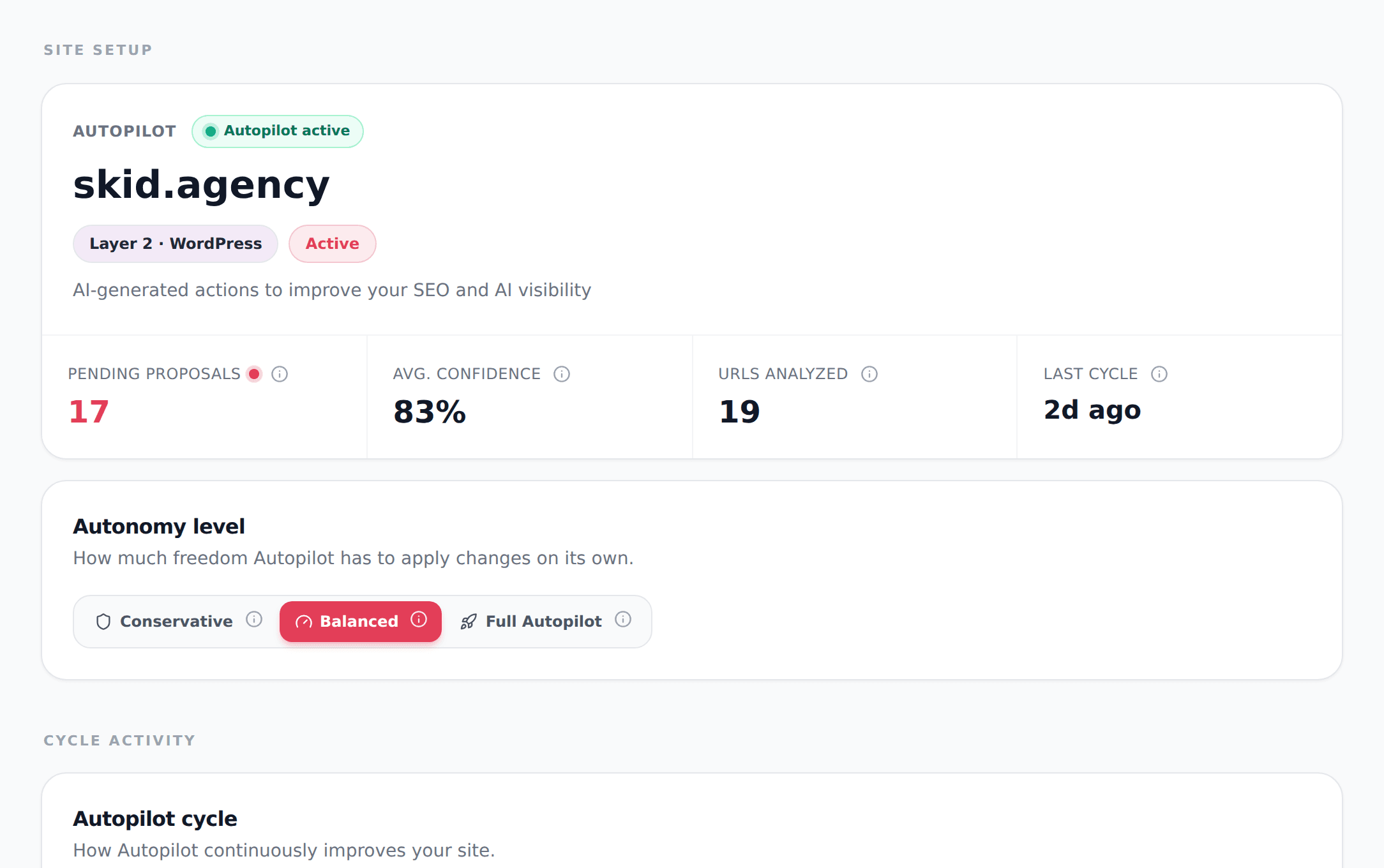
Autonomy isn't all-or-nothing. It's a dial, and you control it per site.
Conservative
Every site starts here. Everything else queues for your approval.
Balanced
Low-risk fixes execute automatically. Everything else still queues.
Autopilot Total
High-confidence fixes execute automatically across low and medium risk. Only high-risk actions (like robots.txt) still require your approval.
There's no wrong level to start at. Most clients start conservative, watch a few cycles of proposals and reverts, and raise the dial once they trust the pattern, not before.
Whatever your stack, Autopilot works with it.
Most SEO tools assume you're on WordPress, or they assume you have a developer on call. Autopilot doesn't assume either.
Native integrations:
WordPress, Shopify, Webflow, HubSpot
Autopilot connects natively and writes directly to your site's meta tags and schema markup: no ticket, no developer, no deploy. Bigger changes, like new content blocks, alt text, redirects, and AEO copy, go through the same diagnostic process and land in your approval queue with the exact text ready to publish.
Running something custom?
Next.js, Drupal, headless Contentful, or any stack without a native connector. Autopilot still runs the full diagnosis. Instead of writing directly, it opens a pull request in your GitHub repo with the exact code change. Your team reviews it like any other PR, merges when ready. If the fix doesn't improve the metric, Autopilot opens a second PR that reverts it. It never forces a rewrite of your merge history.
No CMS at all?
Even a site with zero write access still gets the full cycle: real diagnosis from your GSC, GA4, and AI visibility data, prioritized fixes with exact before/after diffs, and re-measurement to confirm what worked. You or your team applies the change manually. Autopilot still tracks whether it moved the needle.
The pattern doesn't change. Only who presses the button does.
What if it gets it wrong?
Every autonomous action has a verification window built in. Autopilot doesn't just make a change and move on: it measures whether that change actually worked, then acts on the result.
The cycle, in practice: when Autopilot writes a change directly to your site, the next cycle re-measures the exact metric that change was supposed to move. If it improved, it stays: no action needed from you. If it didn't, Autopilot reverts that change automatically and shows you why in your dashboard. For changes it opens as a GitHub pull request, a failed re-measurement gets a second PR that reverts the diff, and your team merges it like any other.
No email you have to catch. No ticket you have to file. The system that made the change is the same system that catches its own mistake.
You control how much autonomy it gets. The autonomy dial (Conservative, Balanced, or Autopilot Total) sets how confident Autopilot needs to be before it acts without asking. Start conservative. Every new site does. Raise it once you've watched it work.
What Autopilot never touches
Autonomy isn't the same as unrestricted access. Some things stay off-limits no matter how high you set the dial:
- Navigation and menu structure: never rewritten
- Layout and design: never changed
- Pages or posts: never deleted
- Plugins or app configuration: never modified
- Anything flagged high-risk, like robots.txt (which controls whether search engines can crawl your site at all), always requires your explicit approval, even on Autopilot Total
Autopilot writes what moves metrics fastest (meta tags and schema) directly. Bigger changes like alt text, redirects, and AEO content go through the same review queue. It doesn't touch what defines how your site looks or how visitors move through it. That line doesn't move, regardless of plan or autonomy level.
Built for how you actually work
CMOs managing multiple brands
Every brand site gets the same diagnostic rigor without pulling engineering time from any of them. Track AI visibility and technical SEO side by side across your whole portfolio, in one place.
Corporate teams without a developer on call
The gap between 'we know what's broken' and 'someone fixed it' used to mean waiting for a sprint. Autopilot closes that gap for WordPress, Shopify, Webflow, and HubSpot sites directly. No developer required for the fixes that matter most.
Agencies managing multiple clients
Run Autopilot across every client site from one dashboard. Set autonomy per client based on how much trust you've earned. Every proposed, applied, and reverted change lives in one audit trail per client, ready to pull up in your next review meeting.
Frequently Asked Questions
Your site changes. So does the AI reading it. Autopilot keeps watching, cycle after cycle.
No credit card required. See your first diagnosis in 2 minutes.